The Coastal Resources Management Council's Rights of Way Subcommittee scheduled another hearing on CRMC File 2020-11-084, Spring Avenue Extension, for Tuesday evening, October 20, at the Westerly Senior Center, 39 State Street. The agenda had four items: call to order, an opening statement from the chair on the hearing process, the Spring Avenue file, and adjournment. It did not list a vote. Public comment had to be given in person. Remote viewers could watch on Zoom but could not speak.
That agenda reflects where the case is now. The question is whether a short paper road near Weekapaug Point is a public way to Quonochontaug Barrier Beach. It is no longer being settled by public comment, by the Town Council or by a single court ruling. A subcommittee is hearing it one witness at a time, and the evidence is mostly maps and municipal records from around 1940. Since November 2025 the case has moved at the speed of expert testimony, and that pace has done more to shape the outcome than anything either side has said.
A Paper Road Leading to a Mile and Three-Quarters of Sand
Spring Avenue, also called Spring Avenue Extension or Spring Lane, appears on some maps. It has no pavement and no street signs. The Town of Westerly has asked CRMC to designate it a public right-of-way to the shore. The Weekapaug Fire District owns the neighboring property and says the strip belongs to the district alone and was never a public way to the beach.
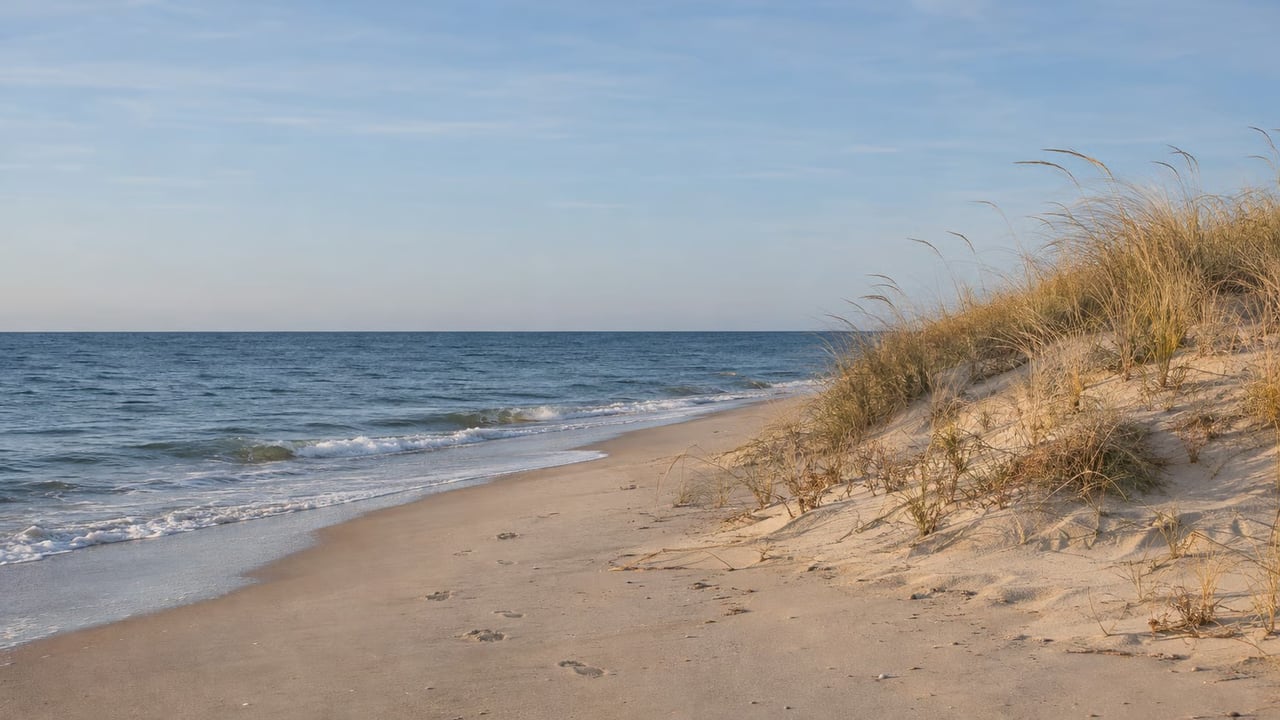
What hangs on the path is the beach beyond it. Ocean State Media reported in April 2025 that the fire district controls access to Quonochontaug Barrier Beach, a 1.7-mile stretch of sand in Westerly. At that time the district let the public use its boardwalk in the off-season and reserved it for residents from 9 a.m. to 6 p.m. in summer. The same report said a public right-of-way designation for Spring Avenue would open the beach to the public year-round.
Why Old Paperwork Decides This Case
The disagreement depends on records that are older than most houses in the village. The Westerly Sun reported one supporter's argument, made by Attorney Michael Rubin. He cited an April 1939 revision plat for Spring Avenue that carries approval stamps from the town's Zoning Board and town clerk, along with a Highway Commission endorsement that the way was safe for travel. He also pointed to an early-1940s aerial photograph that he said shows the extension clear and passable.
Attorney Joseph Farside represents the fire district. According to the same Sun report, he answered with a 1940 report that the Town Council commissioned and adopted, which he said confirms the extension was not a public right-of-way to the shore. He also cited town legal opinions from 2008 and 2020 that did not find a public way. His standard, as the Sun quoted it: "Clear intent to dedicate by the fire district, and clear acceptance by the town. 'Maybe it is and maybe it isn't' is simply not enough."
Each side's argument rests on a document from the same few years, and each document needs witnesses to explain it. That is why the subcommittee's later sessions have been evidence-taking and not debate.
How the Hearings Have Gone
Here is the record from the past two years, drawn from CRMC's posted agendas and minutes and from regional news coverage:
Date | What happened | Merits decision? |
|---|---|---|
Apr. 8, 2025 | Subcommittee unanimously denied the fire district's motion to stay CRMC proceedings during Superior Court litigation | No |
Sept. 15, 2025 | Public-comment hearing in Westerly | No |
Nov. 4, 2025 | First evidentiary hearing; testimony from title attorney Joseph Priestly | No |
Jan. 6, 2026 | Scheduled hearing canceled over an incorrectly filed public notice | No |
Feb. 10, 2026 | Staff progress report only | No |
Apr. 13, 2026 | Testimony from Paul Iemma and Alfred Diorio, the Attorney General's expert surveyor | No |
Aug. 25, 2026 | Full Council briefed; Spring Avenue listed as still under review | No |
Oct. 20, 2026 | Further public hearing scheduled at the Westerly Senior Center | Agenda listed no vote |
The September 2025 hearing drew a large turnout. ecoRI News reported that more than 40 people signed up to testify for or against the designation. The November session covered by ecoRI was smaller and more technical. A title attorney testified, and both sides argued over the historical plats, past public use and ownership. From that point on, each step needed another expert, another notice filed with the Secretary of State and another evening on the subcommittee's calendar.
At the full Council meeting on August 25, staff presented an update on public access that named Spring Avenue Extension and Buttonwoods as proposed rights-of-way still under review. One Council member asked whether members could help staff with right-of-way research. Mr. Willis responded that staff would welcome the help if Legal Counsel and the Chairman agreed. Even members of the Council were offering to help work through the backlog.
The Cost of Waiting
Save The Bay argues that delay favors one side. In a February 2026 letter to CRMC Chair Raymond Coia, which ecoRI News reported, the Providence nonprofit criticized what it called the agency's "persistent and inexcusable delay," and wrote:
"Opponents to this ROW have used the lack of an efficient scheduling process to their advantage and will likely continue to do so."
The letter also raised a specific concern about the evidence. Written records, witness testimony, physical markers and evidence of historical use all change over time. In a case that depends on what people saw and stamped around 1940, every month of delay is a month in which that evidence can deteriorate.
The cost is also measured in dollars. The Westerly Sun reported figures from Town Solicitor William Conley showing that Westerly's legal costs across six shoreline matters came to $366,294.49 from July 2023 through August 2025. Spring Avenue accounted for the largest share. It cost $123,781 for the CRMC application and $95,858 for the related lawsuit, compared with $55,132 for the Sand Trail lawsuits and $91,523 for the Fort Road and Napatree Point case in Watch Hill. Those figures stop in August 2025, before the evidentiary hearings began.
The Courtroom Track and the Neighboring Cases
The fire district has also gone to court. The Sun reported that the district filed actions over Spring Avenue in both Providence County and Washington County Superior Courts. A judge dismissed the Providence action in the town's favor. As of that report, the town was still waiting for a ruling on its motion to dismiss in Washington County. In April 2025 the CRMC subcommittee refused to pause its own proceedings, according to its posted minutes, so the two tracks are running at the same time.
Two other Westerly access cases are easy to confuse with this one:
- The Sand Trail. This is a separate Weekapaug dispute. The town won the district's contempt actions in Washington County and Providence County, and the Sun reported that the Sand Trail's legal status was still before a judge in Washington County Superior Court.
- Everett Avenue.ecoRI News reported that CRMC designated this Westerly path a state right-of-way in November 2025. It was a separate file from Spring Avenue, and it shows the Council can carry a contested case to a final designation.
The rights underneath all of these cases come from Rhode Island's constitution, which protects the right to fish, gather seaweed, swim and walk along the shoreline. Designated rights-of-way are the routes people use to reach that shoreline.
Settled and Unsettled, as of This Week
Settled:
- CRMC is continuing to hear the case after its subcommittee denied the district's motion to stay in April 2025.
- The public-comment phase in Westerly has taken place, and evidence-taking has been underway since November 2025.
- Everett Avenue is a designated state right-of-way. Spring Avenue is not.
Still open:
- Whether Spring Avenue Extension is a public right-of-way to the shore.
- How the Washington County Superior Court has ruled or will rule on the district's Spring Avenue suit.
- What came out of the October 20 session and when the subcommittee will meet next. CRMC posts agendas and minutes on its News and Events page.
No Spring Avenue designation has been made, and the most recent published account of access to the barrier beach is the 2025 seasonal boardwalk arrangement Ocean State Media described. This summary is general information, not legal advice. Anyone with a question about access to a specific property should check with a qualified attorney and the agencies involved.
If you own along the Quonochontaug shore or are considering a Weekapaug property where beach access matters, The Agency Narragansett follows the Spring Avenue record as it develops and can walk you through the public filings alongside your attorney's advice. Schedule a Private Consultation.